

Case Study: Online Retail (Denver, Colorado)
Specialty retail and e-commerce business selling log home maintenance products through a website and an on-site retail presence.
Engagement Snapshot
- Results: Increase Monthly Sales from $1K to $14K in 6 months
- Engagement Dates: March 2014 to September 2015
- Industry: Specialty retail and e-commerce for log home maintenance products
- Location: Denver, Colorado
- Team: 2 on staff
References Policy
My work with clients is confidential by default. Most engagements involve sensitive operational details, financial context, internal team dynamics, and customer data. I do not disclose client information, internal documents, or private communications unless the client has explicitly authorized it.Any public examples on this website are shared only to the extent a client has approved. In some cases, clients have given permission for limited disclosure such as photos together, a short written quote, or select clips from recorded coaching sessions. When those assets appear, they reflect client consent for that specific use only and do not imply broader permission to share additional details.If you are considering hiring me and would like references, I can provide them when appropriate, subject to client availability and confidentiality constraints. In all cases, I will protect client privacy and honor any restrictions requested by the client.Executive Summary
The company was founded in 2008 and grew steadily but slowly in a niche market. By March 2014 the business lacked a consistent system for internet marketing, measurement, and follow-up. Demand capture and repeat purchasing were inconsistent, and decisions about marketing campaigns were hindered because attribution and reporting were unavailable.
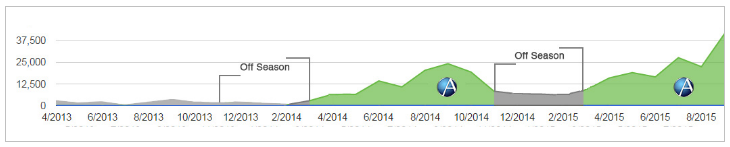
As Fractional COO, I installed a practical operating rhythm: capture leads reliably, measure what drives orders, follow up consistently, and reduce purchasing friction. I paired system changes with staff training and a monthly KPI review cadence so execution continued between check-ins. Within six months of implementing the new cadence and workflows, monthly sales rose from approximately $1,000 to approximately $14,000.
- Monthly sales: $1,000/month to $14,000/month within the first 6 months (+1,300%).
- Customer list size: 103 customers to 353 customers in 1 year (+243%).
- Operational outcomes: Enabled call center order processing and improved customer education, contributing to fewer support requests and more purchases.
Starting Point: What Was Breaking
- Marketing tools were available but underutilized, limiting lead capture and repeat purchase prompting.
- Limited visibility into which marketing methods produced profitable traffic and orders.
- Abandoned carts had minimal recovery, allowing interested buyers to slip away without follow-up.
- Product and site content were not fully leveraged for SEO and customer education.
- Catalog browsing created friction for products with many options, increasing confusion and drop-off.
- Growth execution depended on owner bandwidth rather than a repeatable cadence and trained ownership.
Objectives for the Engagement
- Install an online marketing operating system that the owner and team could maintain.
- Improve lead capture and implement a clear follow-up sequence to convert visitors into buyers.
- Create reporting systems so paid advertising conversions could be measured.
- Recover otherwise lost revenue through cart abandonment workflows and offered incentives.
- Increase discoverability and customer confidence through structured content and SEO improvements.
- Train staff so workflows run consistently between monthly KPI reviews.
What I Changed: The Interventions
Operating Cadence and Accountability
- Established a monthly check-in cadence to review KPIs, marketing results, and set next priorities.
- Trained staff on repeatable workflows so execution continued consistently between reviews.
- Defined expectations for monitoring lead capture health and follow-up consistency.
Financial Visibility and Decision Support
- Implemented tracking URLs to attribute traffic and conversions to specific campaigns.
- Structured promotions using trackable coupon codes so incentives could be evaluated and adjusted.
- Built a habit of reviewing campaign performance as part of the monthly KPI cadence.
Sales Follow-Up and Pipeline Discipline
- Implemented lead capture with an automated email delivering a 10% discount offer.
- Created an abandoned cart workflow with phone and email follow-up to recover orders and learn hesitation reasons.
- Coached offer timing so discounts supported conversion without becoming the assumed default price.
Process, Tools, and Delivery Systems
- Applied SEO meta tags and trained staff to maintain metadata as a routine step for new content.
- Built a dictionary system to explain unfamiliar terms and create structured internal linking for education and SEO.
- Implemented product variations so shoppers could select options within a single listing, reducing catalog friction.
- Improved shopping cart readiness to enable outsourced order processing with clean handoffs.
KPIs and Outcomes
| Metric | Before | After | Change | Timeframe/Date Notes |
|---|---|---|---|---|
| Monthly sales | $1,000/month | $14,000/month | +1,300% | Within first 6 months after March 2014 |
| Customer list size | 103 names | 353 names | +243% | Net +250 in 1 year |
| Ops scalability | Owner and internal team only | Enabled call center order processing | Operational leverage | Supported by shopping cart improvements |
- Before
- $1,000/month
- After
- $14,000/month
- Change
- +1,300%
- Timeframe
- Within first 6 months after March 2014
- Before
- 103 names
- After
- 353 names
- Change
- +243%
- Timeframe
- Net +250 in 1 year
- Before
- Owner and internal team only
- After
- Enabled call center order processing
- Change
- Operational leverage
- Timeframe
- Supported by shopping cart improvements
Lead capture and automated follow-up improved conversion from existing traffic. Tracking URLs created attribution so paid campaigns could be evaluated rationally. Abandoned cart outreach recovered revenue and produced feedback that informed prioritization. Content and catalog improvements reduced buyer confusion, supporting both conversion and scale.
Timeline of Key Moments
- 2008 – Company founded; operated with slow, incremental growth in a niche market.
- February 2014 – End of the owner’s 6-year solo-run.
- March 2014 – Engagement began.
- September 2014 – Monthly sales increased from $1,000/month to $14,000/month.
- March 2015 – Customer list grew from 103 names to 353 names.
- September 2018 – Owner successfully exited as the business was sold.
Why This Worked
This engagement worked because it treated growth as an operations problem. The focus was not on isolated tactics, but on installing one repeatable rhythm: capture leads, follow up consistently, measure results, and adjust based on observed performance. That reduced tool chaos and replaced sporadic effort with predictable execution.
Follow-through became measurable through tracking URLs and trackable coupon offers, which improved decision quality. Customer education and catalog simplification reduced friction for buyers and reduced support load. Staff training and the monthly KPI cadence reduced owner dependency and helped preserve momentum.
Transferable Value
- Operational diagnostics that convert scattered activity into a clear operating cadence.
- KPI design and monthly review rhythms that connect marketing activity to revenue outcomes.
- Lead capture and automated follow-up systems that turn traffic into reachable prospects.
- Abandoned cart recovery processes using phone and email follow-up with controlled incentives.
- Campaign attribution using tracking URLs to support rational spend decisions.
- Content operations for customer education, including dictionary-style explanations and internal linking.
- Catalog and purchasing-flow improvements that reduce decision friction for buyers.
- Operational scalability planning, including readiness for outsourced order processing.